Collectors often assume that the main challenge lies in identifying a coin and estimating its value. A coin evaluator helps verify metal, weight, and general parameters, so the process seems clear at the beginning.
Yet the real damage usually occurs later. After a coin is found, photographed, catalogued, and priced, many collections decline because of improper cleaning or unsuitable storage. The loss is gradual, so the owner often does not notice changes until the value has already fallen.
Here, we would like to explore which cleaning habits harm coins, which storage conditions accelerate deterioration, and how to build a stable protection system that preserves long-term value.
Why Proper Handling Matters More Than Many Collectors Expect
Coins react strongly to physical contact, moisture, dust, chemicals, and temperature shifts. Surface changes accumulate slowly and influence the grade directly. Collectors often underestimate this risk because coins look durable.
In reality, most alloys are sensitive to skin oils, fabric fibres, pressure, PVC vapours, and humidity. Even a single attempt to make a coin look “cleaner” can erase the original texture and reduce the grade permanently.
A collection that took years to assemble can lose a third of its value simply because coins were kept in unsuitable holders or were polished in an attempt to improve their appearance.
Proper handling does not require complex procedures. It requires discipline, stable conditions, and a refusal to use household cleaning methods. Once these principles become routine, the collection remains secure even during long-term storage.
Cleaning Mistakes That Permanently Reduce Grade and Market Appeal
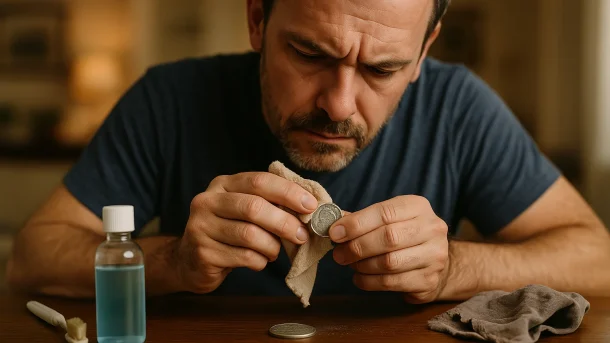
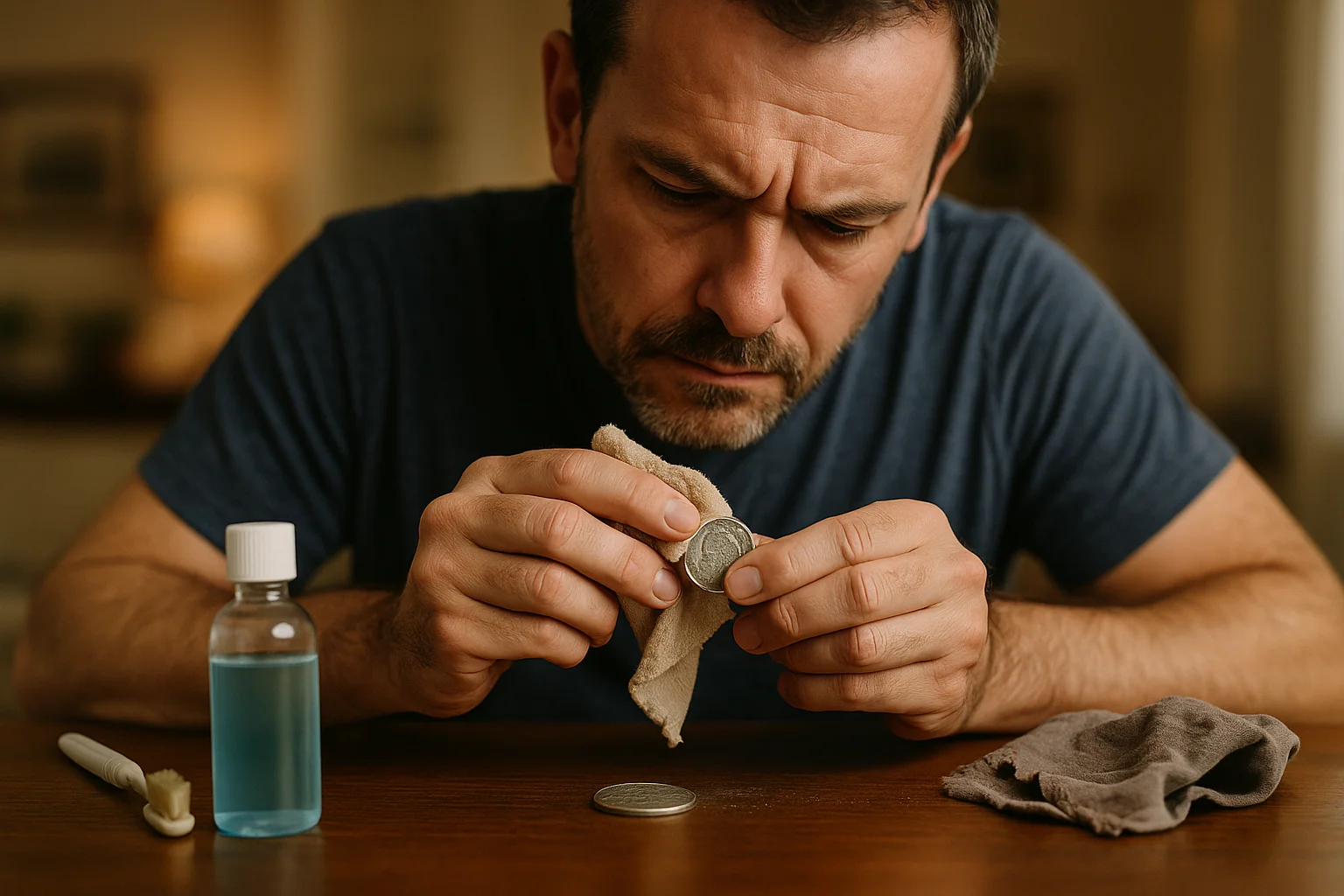
Cleaning is the most common source of damage. Many collectors, especially beginners, want to improve the look of a coin or remove signs of age. This instinct is understandable, but the market punishes any alteration sharply. The surface of a coin contains micro-details that define originality. Cleaning removes exactly these details.
Rubbing or polishing the surface
Rubbing leaves fine scratches. They form a pattern of parallel lines and break the luster. Even mild pressure from a cloth or tissue distorts the surface. Polishing agents create an artificial shine that specialists recognise instantly. Once present, these changes cannot be reversed. The coin will never be considered original again.
- What to do instead: leave the surface as is. If dust appears, remove it with air or a soft, untouched microfiber cloth held above the coin, not rubbed across it.
Using chemical dips
Chemical dips dissolve oxidation, but also dissolve metal. The process removes the top layer of the surface and alters its colour. A dipped coin may look bright for a moment, but the texture becomes flat and unnatural. Graders identify this instantly. The premium disappears, especially on older silver and copper pieces.
- Safer approach: avoid dips entirely. Professional conservation exists, but it is intended for specific cases and requires specialised chemical control.
Attempting to remove toning
Natural toning forms slowly. It provides protection and often increases desirability. Attempts to remove it leave patchy colour and reveal cleaning streaks. Many collectors mistakenly try to create a “white” appearance, but the market punishes unnatural surfaces. Toning is part of the coin’s history and often part of its value.
Brushing, scraping, or using abrasive tools
Toothbrushes, cloths, erasers, and similar objects create micro-cuts. These become visible under soft light. Even coins that already circulated lose value if abrasives create fresh marks that do not match natural wear patterns.
Cleaning ancient and copper coins with water
Copper reacts to water and air. When moisture remains inside pores, corrosion accelerates. Ancient and copper coins should not be cleaned without specialist knowledge. Even distilled water may trigger corrosion if drying is incomplete.
- General rule: if you are not trained in conservation, avoid cleaning entirely. Market value depends on original surfaces, not on brightness.
Storage Mistakes That Accelerate Damage Over Time
Storage errors destroy value slowly but consistently. Many collectors understand the danger of cleaning but underestimate the environmental impact. Incorrect holders, unstable humidity, mixed metal storage, or normal household conditions can cause irreversible changes.
High-risk Storage Materials
Some holders release chemicals. Others trap moisture. The table below shows practical examples.
| Unsafe Material/Method | Why It Causes Damage | Safer Alternative |
| PVC flips and soft plastic holders | Release plasticiser oils; create green residue on copper, silver, bronze | Mylar flips; archival polypropylene |
| Envelopes with acidic paper or glue | Cause stains and corrosion spots | Acid-free paper envelopes |
| Cardboard 2x2s with non-archival glue | Glue vapour affects metal; cardboard traps humidity | Archival-grade 2x2s without PVC |
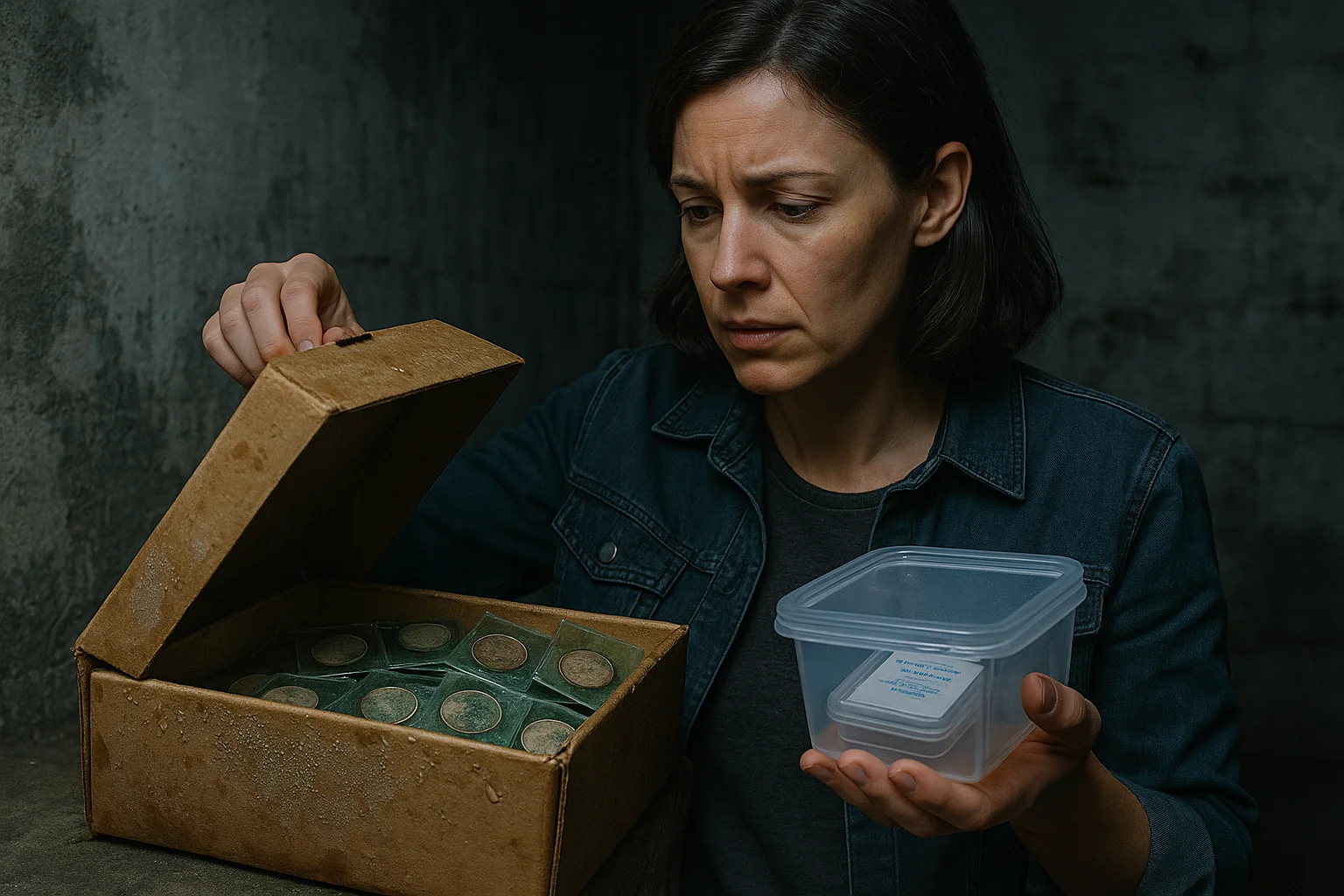
| Airtight jars or boxes without desiccants | Trap moisture inside; allow condensation | Ventilated storage with silica gel |
| Original paper wrappers from decades ago | Paper acidity increases over time | Stable archival containers |
Storing Coins in Humid Environments
Basements, attics, and unheated rooms have large humidity swings. Silver tarnishes faster, copper develops active spots, and nickel darkens unevenly. Heat sources near shelves dry out holders, creating cracks and uneven pressure on the surface.
- Stable target: 30–50% humidity, consistent temperature, away from sunlight.
Storing Silver and Copper Together
Metals interact. Silver and copper influence each other when stored in direct contact or in sealed environments. One piece may develop unnatural toning; another may accelerate corrosion. Segregation prevents cross-reaction.
Mixed-grade storage
High-grade coins should not be kept next to bulk circulated pieces. Movement of heavily circulated coins inside a box can scratch higher-grade surfaces.
Handling without preparation
Skin oils contain compounds that degrade metal. Fingerprints become corrosion marks. These dark areas penetrate the surface and cannot be removed without altering the metal.
- Solution: hold coins by the edges; use cotton or nitrile gloves; avoid working over rough surfaces.
Albums and pages near heat or light
Plasticisers soften under heat and migrate onto surfaces. Sunlight causes uneven toning. Pages dry out, warp, or stick to coins if the temperature fluctuates.
Safe Alternatives: What You Can Actually Do Without Risk
Collectors often hear a long list of prohibitions, so it is useful to know what can be done safely. Basic handling is simple as long as the surface remains untouched. Rinsing with distilled water is acceptable in rare cases, such as removing loose dust.
The key rule is zero friction. Drying must happen without cloth contact, so the coin rests on an inert surface until moisture evaporates. After that, the coin goes directly into a stable holder.
Safe handling works best when paired with predictable storage. The table below outlines common situations and the correct response.
| Situation | Safe Action | What to Avoid |
| Dust | Distilled rinse | Cloth wiping |
| Soil | Professional conservation | Household chemistry |
| Long-term storage | Inert holders | PVC flips |
These measures preserve the surface and reduce the risk of accidental marks or chemical reactions. They are simple habits, but they maintain originality better than any form of cleaning.
Storage Mistakes That Destroy Value Over Time
Storage problems cause slow, cumulative damage. The grades may still appear acceptable, yet the market reacts sharply to irregular colour, active corrosion, or disturbed luster. Many errors look harmless at first, but each has a clear mechanism and a predictable outcome.
The table below shows how specific conditions affect metal over time.
| Mistake | Reason | Consequence |
| PVC flips | Release of plasticisers | Green residue, sticky film |
| Humid rooms, basements, attics | Unstable temperature, trapped moisture | Corrosion, spotting |
| Airtight containers without desiccants | Sealed humidity | Accelerated tarnish |
| Mixing silver, copper, and nickel | Cross-metal reactions | Toning stains, uneven discolouration |
| Frequent handling without washing hands | Skin oils turn acidic | Long-term surface etching |
| Albums near heat or sunlight | Heat + UV | Drying, yellowing, warping |
| Paper envelopes with acidic glue | Acid migration | Brown spots, permanent stains |
These reactions explain why surfaces change even when coins remain untouched. A stable environment matters as much as the choice of holder. Once a chemical change begins, reversing it without harming the surface is nearly impossible.
How to Build a Stable Long-Term Storage System
A strong storage system depends on predictable conditions. Most coins tolerate stable temperature and controlled humidity. Problems appear when holders react with metal or when wide fluctuations occur in the environment. Collectors can avoid this by combining inert materials with consistent climate control.
A practical long-term setup includes:
- Holders made from Mylar, PET, or archival-grade board;
- Relative humidity between 30–45%;
- Silica gel packets are placed in storage boxes and replaced regularly;
- Separation of metals to prevent colour transfer.
- Avoidance of direct heat sources or windows.
A short sequence helps organise a new storage area. Metals should be separated so their colours do not transfer onto one another during long storage. Humidity must remain stable, which is easiest to achieve with desiccants placed inside sealed containers. Only inert holders and archival materials should be used, since reactive plastics create problems later.
Periodic inspections every six to twelve months help catch early changes in colour or texture. Friction must be avoided entirely, so coins are stored without touching and handled only by the edges.
These steps minimise chemical activity and preserve original surfaces, which are the primary drivers of collector value.
Tracking Condition Over Time
Condition changes slowly, so early signs appear long before a coin loses grade. Documentation becomes part of proper care because it shows issues that are not visible at first glance. Consistent photography in the same light reveals new spots, tone shifts, or small texture changes. A simple routine keeps the process organised:
- Take clear photos after each inspection;
- Record any new marks or colour changes;
- Compare the results with earlier images.
Digital tools support this workflow. A coin appraisal app helps track how condition affects value ranges. Coin ID Scanner stores identification details together with photo records, turning the archive into a structured timeline.
Regular tracking builds discipline. It encourages collectors to notice surface changes early, adjust storage conditions, and prevent long-term damage. A documented history also improves buyer confidence if the coin is ever sold.
A Practical Checklist: What to Do and What to Avoid
A short checklist provides a stable framework for daily use.
Do:
- Use inert holders and archival materials;
- Store metals separately;
- Maintain moderate humidity;
- Handle coins by the edges;
- Document condition regularly.
Avoid:
- PVC and soft plastic products;
- Any friction, wiping, or rubbing;
- Rapid temperature changes;
- Household chemicals;
- Acidic paper or cardboard.
These rules stay constant regardless of metal, series, or grade.
Simple Habits That Preserve Real Value
Collections lose value not from age, but from neglect. Stable conditions, inert materials, and careful handling protect surfaces that drive market demand. And remember that the coin worth app can extend this protection by organising information and helping collectors recognise early warning signs. A structured routine removes risk, preserves originality, and maintains long-term value without complicated methods.