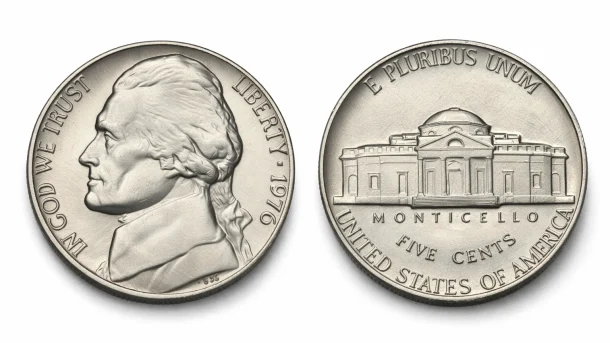
The 1976 nickel value does not begin with rarity. It begins with quality. The date is common, and most coins carry only a small premium. The market changes when the strike is stronger. That is where Full Steps become more important than the date.
The 1976 Jefferson Nickel Basic Overview
The 1976 nickel is a standard Jefferson five-cent coin. It is not a special Bicentennial nickel type. The major Bicentennial design changes in 1976 affected the quarter, half dollar, and dollar, not the nickel.
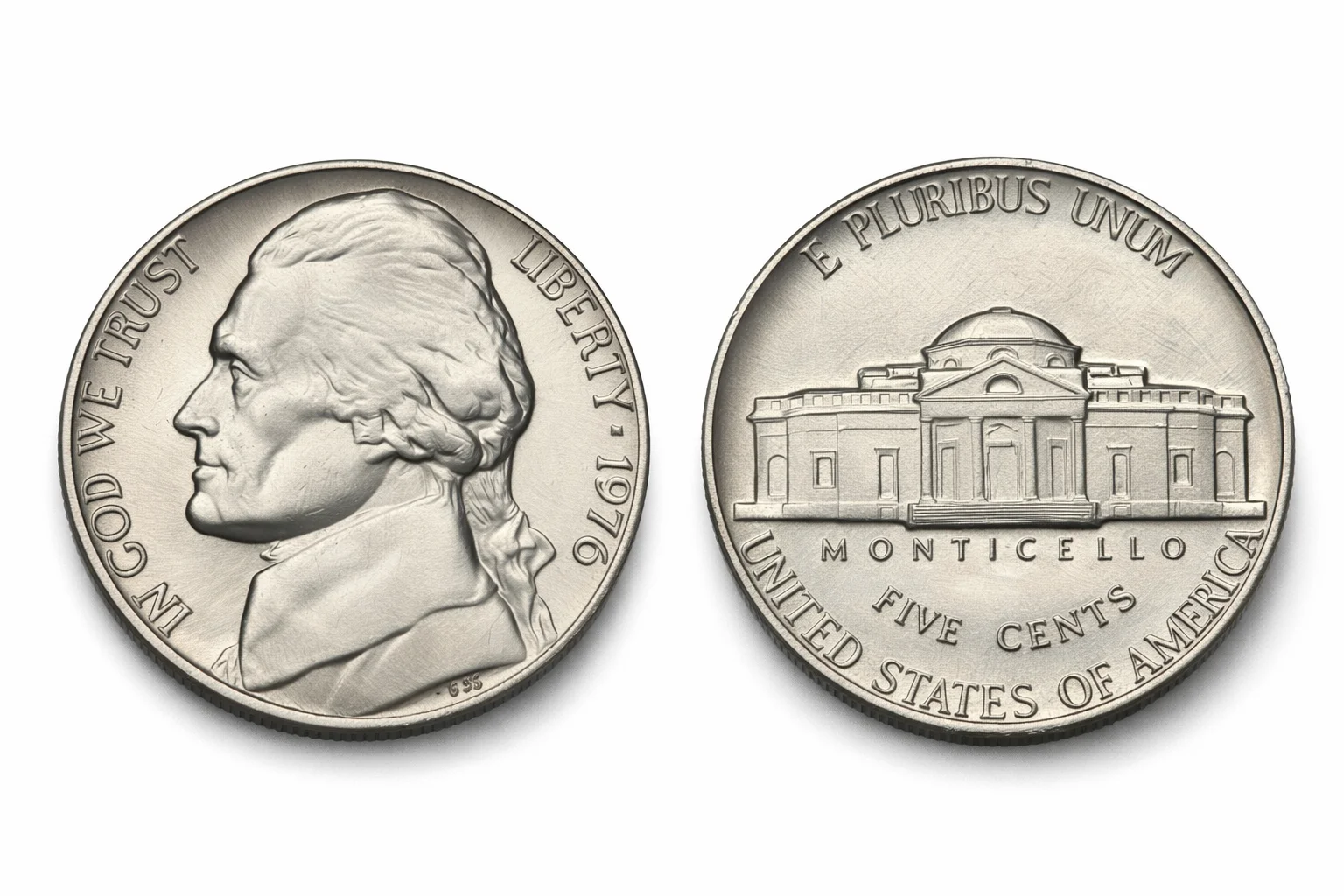
The 1976 Jefferson nickel keeps Felix Schlag’s portrait of Jefferson on the obverse and Monticello on the reverse. It uses the normal copper-nickel composition for the period: 75% copper and 25% nickel. Weight is 5.00 grams. Diameter is 21.20 millimeters. The edge is plain.
Before discussing value, the three versions need to be separated. That step matters because they do not belong in the same market.
| Type | Mint mark | Format | Main market role |
| 1976 | None | Business strike | Circulation coin |
| 1976-D | D | Business strike | Circulation coin |
| 1976-S | S | Proof | Collector issue |
The Philadelphia and Denver coins belong to the regular circulation side of the market. The San Francisco coin belongs to the proof side. This is the first split a collector should make.
Mintage and Supply
The supply picture explains why the lower end of the market stays flat. Detailed numbers are in the table below. That strong survival rate keeps ordinary proof examples available.
| Type | Approximate mintage |
| 1976 | 367,124,000 |
| 1976-D | 563,964,147 |
| 1976-S Proof | 4,149,730 |
This table shows the basic market logic. Large business-strike mintages keep most 1976 nickels inexpensive. The proof coin is more limited, but still not rare in normal proof grades, because collectors preserved so many.
What Actually Affects the Value of a 1976 Nickel
For this year, value does not come from the date alone. It comes from a short group of factors:
- Business strike or proof
- Grade
- Strike sharpness
- Surface quality
- Full Steps on business strikes
- Deep Cameo quality on the proof
That list matters because it keeps the article honest. A common date can still bring a strong premium. The reason is usually quality, not calendar appeal. For example, circulated 1976 and 1976-D nickels are around $0.10 to $0.20. Ordinary Mint State examples are about $0.55 to $3.62 or more. That is a modest range. The bigger jump comes later, when grade and strike quality rise together.
Why the Date Alone Does Not Make the Coin Valuable
This is the point many collectors miss. A 1976 nickel is not a key date. It is not a low-mintage outlier. It is not a famous one-year subtype. In circulated condition, it is common. In lower Mint State, it is still easy enough to find. PCGS says the 1976 Philadelphia issue is very common in circulated grades and up to about MS64. That tells you where the easy part of the market ends.
The Denver issue follows the same pattern at the low end. PCGS describes 1976-D as really common in circulated grades, even with a mintage of over half a billion. That is why the year itself does not drive the premium. If the date were the main factor, all 1976 nickels would be expensive. They are not. The premium appears only after the collector starts asking for more than just “uncirculated.”
What “Full Steps” Means
Full Steps is the key quality term for many Jefferson nickels. FS is a clearly defined striking detail on the steps of the Jefferson Memorial building. This refers to the steps at the base of Monticello on the reverse. When those steps are full and clean, the coin shows a stronger strike. Collectors notice that quickly. Registry collectors notice it even more.
| Feature | Regular strike | Full Steps coin |
| Step detail | Soft or broken | Clearly separated |
| Collector demand | Normal | Stronger |
| Price effect | Modest in most grades | Premiums can rise fast |
| Market role | Common set coin | Better-grade target |
This is why Full Steps matters more than the date. The date tells you the coin is common. The steps tell you whether the strike is better than average. That difference changes the market. Greysheet notes that regular-strike Jefferson nickels with five or six full steps are significantly scarcer than examples with softness in that area.
The Philadelphia Issue: Ordinary Until the Steps Improve
The Philadelphia coin is a good example of how this works. PCGS says the 1976 Jefferson nickel is very common through about MS64. Then the Full Steps problem begins. Because of weakness in the reverse steps, it is difficult to find in MS65 Full Steps, with fewer than 100 examples known, and difficult again in MS66 Full Steps, with fewer than a few dozen examples known. That is a major change in scarcity without any date change.
GreatCollections supports that market split with archived sales. It reports that it has sold 1976 Jefferson Nickel FS coins from $9 to $1,695 in grades 64 to 67. That range is far above what ordinary circulated or average Mint State pieces bring. It also shows the real point of the designation. Full Steps does not make a common coin rare in every grade. It creates a much narrower market once the grade is high enough to matter.
The Denver Issue: Where the Premium Can Get Stronger
Denver is even more interesting at the top. The 1976-D Jefferson nickel is really common in circulated grades, but very scarce in MS66 or higher. The MS66 Full Steps is very difficult to find, and coins above MS66 or MS66FS are very rare or possibly non-existent. That is strong language for such a common-date coin.
The FS market confirms it. GreatCollections says it has sold 1976-D Jefferson Nickel FS coins from $6 to $717 in grades 1 to 67. PCGS lists an auction record of $2,040 for an MS67FS coin. Those are not normal prices for a half-billion-mintage nickel. They are prices created by strike quality and certified grade. The date did not change. The step detail did.
A simple comparison helps:
- 1976 or 1976-D in circulated condition: common
- 1976 or 1976-D in average Mint State: still modest
- 1976 or 1976-D with Full Steps in better grades: a much smaller market
- 1976-D in top FS grades: one of the harder outcomes for the year
That is the real value structure.
Surface Quality Still Matters
Full Steps is not the whole coin. A nickel can show decent step detail and still look average. Surface preservation still matters. Marks in the fields, weak luster, distractions on Jefferson’s cheek, and dull overall appearance can hold a coin back even when the reverse is better than normal. That is why strong Jefferson nickels are not built from one detail alone. They are built from strike plus preservation.
A practical checklist for a 1976 nickel looks like this:
- Check the steps first
- Check the fields next
- Check Jefferson’s portrait for marks
- Check the luster
- Compare the total eye appeal, not just one feature
This is also why many buyers prefer certified examples in the better ranges. The gap between “average Mint State” and “better Mint State” is wider than many beginners expect.
The 1976-S Proof Is a Different Market
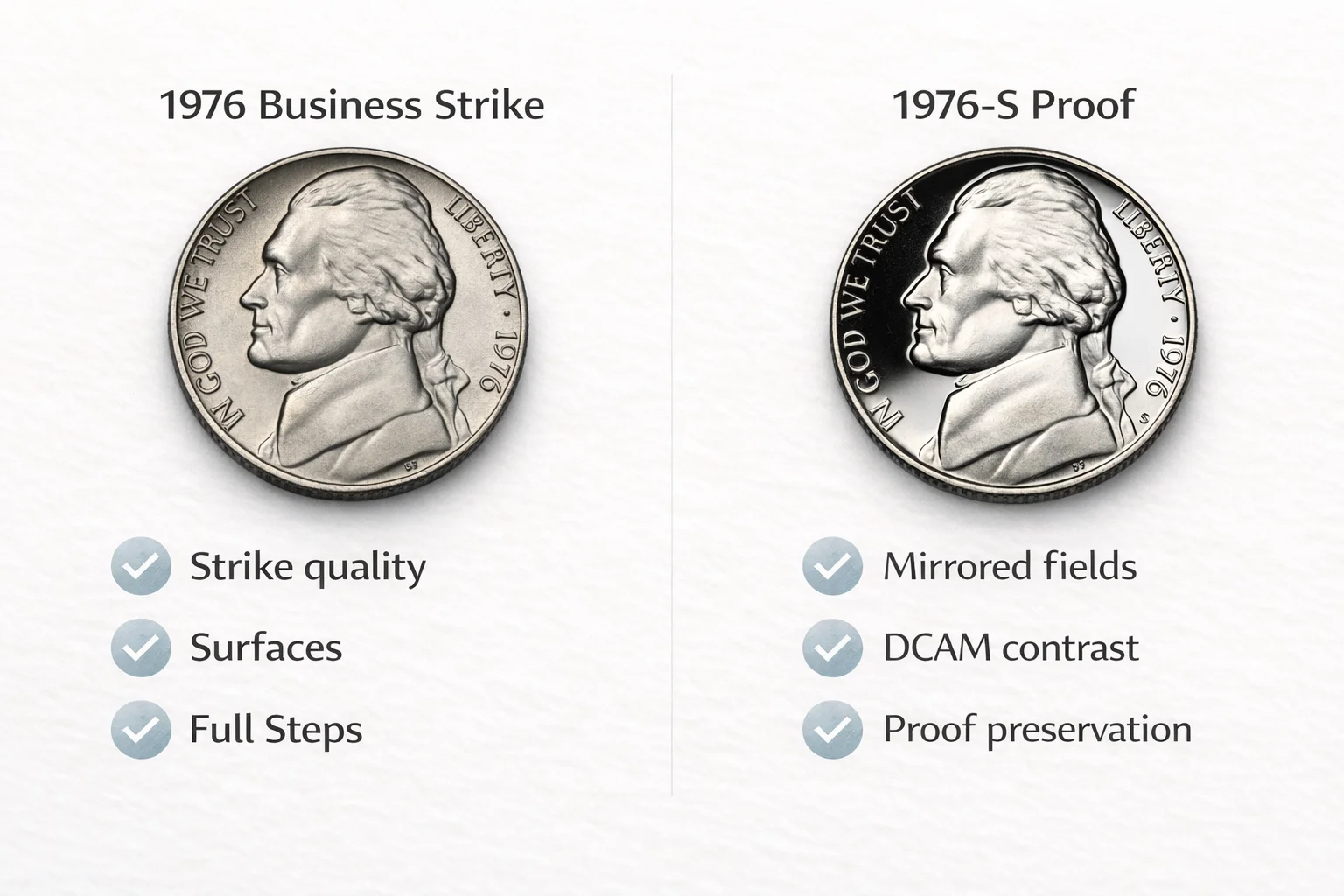
The 1976-S proof needs a separate discussion. Proof nickels were struck for collectors, not circulation. They were made with a mirrored surface and handled differently from business strikes.
The 1976-S Jefferson nickel is common up to PR69 Deep Cameo and becomes scarce only in perfect PR70 Deep Cameo. That tells you how the proof market works: broad supply in normal proof grades, much stronger prices only at the very top.
| Feature | 1976 business strike | 1976-S proof |
| Purpose | Circulation | Collector issue |
| Main premium factor | Grade and Full Steps | Proof quality and DCAM contrast |
| Lower market | Very modest | Modest collector premium |
| Upper market | Strong with FS | Strong in PR70 DCAM |
USA Coin Book places the 1976-S proof at about $3.08 or more. That is a normal collector level, not a rarity price. The big difference starts only when the proof reaches the very highest cameo grades. PCGS shows an auction record of $4,230 for the DCAM proof type. Again, the lesson is the same. Quality drives the premium.
Practical Value Structure
Once the types are separated, the market reads more clearly.
| Type | Lower market | Typical collector level | Higher-end market |
| 1976 | About $0.10–$0.20 circulated | About $0.55–$3.62+ in Mint State | Much stronger with FS |
| 1976-D | About $0.10–$0.20 circulated | About $0.55–$3.62+ in Mint State | Much stronger with FS |
| 1976-S Proof | Modest proof level | About $3.08+ | Much stronger only in top DCAM grades |
This table is not meant to show every grade. It shows the structure. The ordinary market stays flat. Better business strikes jump because of Full Steps and strong preservation. The proof stays moderate until the very top. That is why the title of this article is true. For the 1976 nickel, Full Steps matters more than the date.
What to Check First
A coin scanner app can help with the first pass. It can confirm the date, the mintmark, and the basic type. That is useful when sorting mixed nickels or checking a group quickly. It is not the final step. The final step still comes from looking closely at Monticello, the fields, and the overall look of the coin.
A simple routine works well:
- Confirm the date and mintmark
- Separate the proof from the business strike
- Inspect the steps
- Inspect the surfaces
- Compare with a stronger coin if possible
That sequence keeps the focus where the market keeps its money.
Tip: Also install a free coin value checker app to organize the early stage of the search. Coin ID Scanner can identify a coin from a photo, show a basic coin card, and list practical data such as type, year, composition, weight, diameter, and edge.
The app also helps keep multiple coins in one collection and gives a quick starting value reference before deeper grading work begins. For a date like 1976, that kind of first sorting can save time.
Conclusion
The 1976 nickel is a common date. That part is simple. The market is not simple. Once the conversation moves from date to strike quality, the coin changes. Full Steps turns an ordinary nickel into a more selective coin. Surface quality pushes the separation further. The proof issue follows its own path. That is the real structure behind the year.
For this coin, the best rule is clear. Look at the date first. Then stop looking at the date. After that, the real value story is in the steps.